

Soil is our strength
SAMPLING RESULTS
At Holmes Agro we are happy to partner with A & L Canada Laboratories Inc. to bring a customized soil test to our growers. Every soil test we submit will show results for the following:
-
Organic Matter (%)
-
The following standard nutrients in ppm:
-
- Phosphorus (as Sodium Bicarb and Bray 1)
- Potassium
- Magnesium
- Calcium
- Sodium
-
Soil pH and buffer pH
-
Calculated CEC
-
K/Mg ratio
-
Saturation of cation elements (%K, %Mg, %Ca, %H and %Na)
-
Phosphorus saturation (%P)
-
The following additional micronutrients in ppm:
-
- Sulphur
- Zinc
- Boron
- Manganese
- Aluminum
-
Estimated Nitrogen Release- ENR (lbs/ac)
At Holmes Agro we are happy to partner with A & L Canada Laboratories Inc. to bring a customized soil test to our growers. Every soil test we submit will show results for the following:
-
Organic Matter (%)
-
The following standard nutrients in ppm:
-
- Phosphorus (as Sodium Bicarb and Bray 1)
- Potassium
- Magnesium
- Calcium
- Sodium
-
Soil pH and buffer pH
-
Calculated CEC
-
K/Mg ratio
-
Saturation of cation elements (%K, %Mg, %Ca, %H and %Na)
-
Phosphorus saturation (%P)
-
The following additional micronutrients in ppm:
-
- Sulphur
- Zinc
- Boron
- Manganese
- Aluminum
-
Estimated Nitrogen Release- ENR (lbs/ac)
OUR SOIL SAMPLING
-
BULK
Bulk sampling begins with dividing the field into broad regions. Within each region, several soil cores are taken and combined as one sample per region. Regions are a maximum of 25ac as per 4R guidelines. -
GRID
Grid sampling uses GPS mapped points to collect multiple soil samples throughout the field. Your field will be divided into a 2.5ac sized grid pattern, and a separate soil sample will be collected from each grid point. -
ZONE
Polygons/Zones are created and sampled based on differences you, or your field data, may have picked up on in your field (ex: yield maps, topography differences, soil texture variances etc). -
SOIL MAPPING
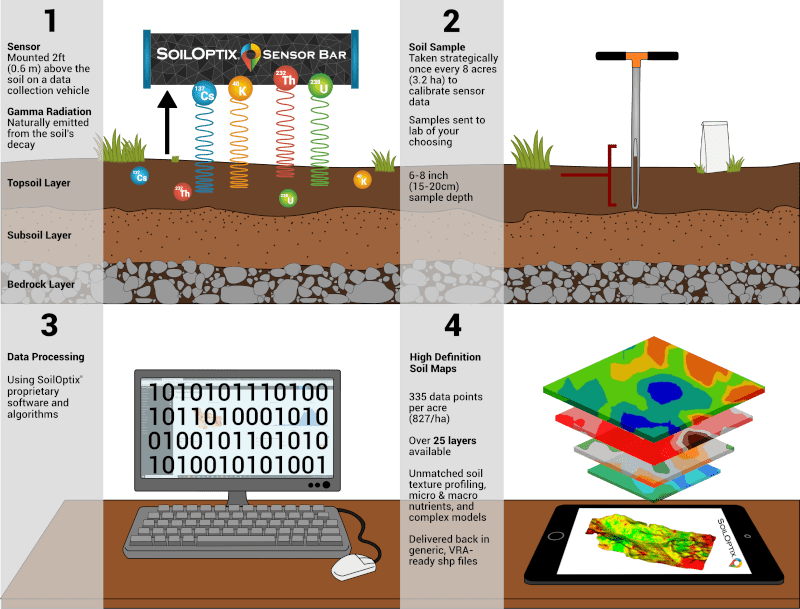
Want to take your decision-making to the next level? Explore the option of soil mapping with Soil Optix. This form of mapping uses sensor technology and soil cores to offer the most in-depth look at your soil.
-
BULKBulk sampling begins with dividing the field into broad regions. Within each region, several soil cores are taken and combined as one sample per region. Regions are a maximum of 25ac as per 4R guidelines. -
GRIDGrid sampling uses GPS mapped points to collect multiple soil samples throughout the field. Your field will be divided into a 2.5ac sized grid pattern, and a separate soil sample will be collected from each grid point. -
ZONEPolygons/Zones are created and sampled based on differences you, or your field data, may have picked up on in your field (ex: yield maps, topography differences, soil texture variances etc). -
SOIL MAPPINGWant to take your decision-making to the next level? Explore the option of soil mapping with Soil Optix. This form of mapping uses sensor technology and soil cores to offer the most in-depth look at your soil.
-
BULKBulk sampling begins with dividing the field into broad regions. Within each region, several soil cores are taken and combined as one sample per region. Regions are a maximum of 25ac as per 4R guidelines. -
GRIDGrid sampling uses GPS mapped points to collect multiple soil samples throughout the field. Your field will be divided into a 2.5ac sized grid pattern, and a separate soil sample will be collected from each grid point. -
ZONEPolygons/Zones are created and sampled based on differences you, or your field data, may have picked up on in your field (ex: yield maps, topography differences, soil texture variances etc). -
SOIL MAPPINGWant to take your decision-making to the next level? Explore the option of soil mapping with Soil Optix. This form of mapping uses sensor technology and soil cores to offer the most in-depth look at your soil.
WOULD YOU SAY YOUR FIELD HAS VARIABILITY?
Interested in doing your own soil sampling?
At minimum all you need is a plastic bag and garden trowel. Please read the following reference guide to learn more in-depth of how to do your own soil sampling.
We also offer manure & compost testing to help growers better understand the nutrient credit their manure or compost offers for crop planning. All analyses are done through our partner A&L Canada Laboratories Inc. Every test we submit will show results for minimum the following (more in-depth tests can be done as well):
-
Dry matter (%)
-
Nitrogen (total %)
-
NH4-N (ppm)
-
Phosphorus (total %) Phosphate (P as P205- % out of total P)
-
Potassium (total %) Potash (K as K20- % out of total K)
MANURE AND COMPOST TESTING
We also offer manure & compost testing to help growers better understand the nutrient credit their manure or compost offers for crop planning. All analyses are done through our partner A&L Canada Laboratories Inc. Every test we submit will show results for minimum the following (more in-depth tests can be done as well):
-
Dry matter (%)
-
Nitrogen (total %)
-
NH4-N (ppm)
-
Phosphorus (total %) Phosphate (P as P205- % out of total P)
-
Potassium (total %) Potash (K as K20- % out of total K)
We also offer manure & compost testing to help growers better understand the nutrient credit their manure or compost offers for crop planning. All analyses are done through our partner A&L Canada Laboratories Inc. Every test we submit will show results for minimum the following (more in-depth tests can be done as well):
-
Dry matter (%)
-
Nitrogen (total %)
-
NH4-N (ppm)
-
Phosphorus (total %) Phosphate (P as P205- % out of total P)
-
Potassium (total %) Potash (K as K20- % out of total K)
We also offer manure & compost testing to help growers better understand the nutrient credit their manure or compost offers for crop planning. All analyses are done through our partner A&L Canada Laboratories Inc. Every test we submit will show results for minimum the following (more in-depth tests can be done as well):
-
Dry matter (%)
-
Nitrogen (total %)
-
NH4-N (ppm)
-
Phosphorus (total %) Phosphate (P as P205- % out of total P)
-
Potassium (total %) Potash (K as K20- % out of total K)

